Introduction
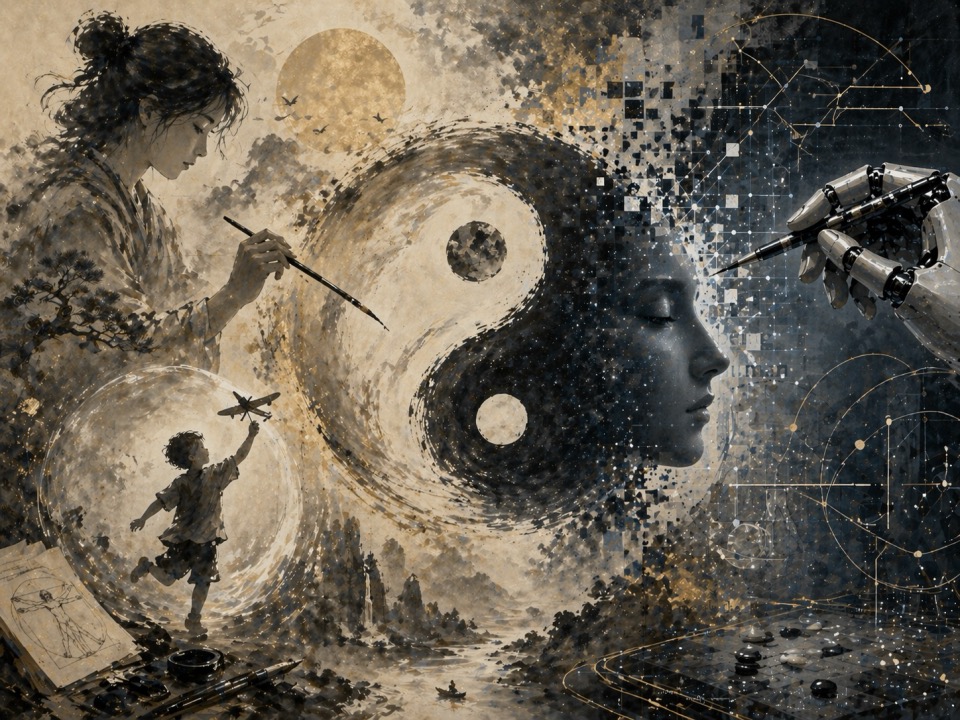
In recent years, the rise of AI-driven art creation tools has sparked debate regarding the nature of art and creativity. While AI can generate highly realistic and seemingly innovative images, its output is not yet widely regarded as part of the artistic mainstream. Unlike human artists, who engage in an evolving dialogue between imagination and reality, AI primarily recombines existing patterns based on statistical probabilities, without clear evidence of genuine understanding, intention, or self-awareness. However, some scholars argue that AI-generated works may constitute a new form of artistic production, particularly in expanding access to creative tools. Nevertheless, this paper maintains that such outputs remain fundamentally distinct from human artistic creation. At the core of this discussion is the concept of subjectivity — the capacity for self-awareness, lived experience, and meaningful reflection — which remains central to human artistic creation.
Artistic Subjectivity and the “True Self”
Artistic emotion requires the expression of the true self, but AI lacks a true self. In this sense, Winnicott’s concept of the “true self” can be understood as a foundation of artistic subjectivity. Winnicott describes creativity as emerging within a “transitional space” — a zone between inner experience and external reality — where imagination and personal meaning take shape. Human artists create from inner emotional experience and use art as a form of self-expression, embodying a spontaneous and sincere creative process.
By contrast, AI-generated art can be understood as a recombination of existing works, aligning more closely with what Winnicott describes as the “false self,” a construction lacking genuine subjective agency. Similarly, while “play” is central to human creativity — enabling experimentation and discovery — AI “exploration” remains structured by training data and algorithms rather than an organic process of meaning-making.
Agency, Reflexivity, and Human Creativity
AI primarily operates based on human input and system design. In contrast, humans can deliberate and act purposefully in relation to personal values, emotions, and social contexts. As Archer suggests, this capacity for reflexive agency is central to human subjectivity. AI, by comparison, appears to lack such initiative, as its “creativity” depends entirely on external input and computational processes.
Art serves as a medium through which humans express emotions, confront ethical dilemmas, and communicate perspectives shaped by lived experience. AI cannot perform such introspection in a human sense. While it may generate images based on themes such as poverty, it does not necessarily capture the lived meaning behind them. Human art therefore involves not only technical execution but also the communication of personal history, cultural context, and moral reflection — elements that AI cannot fully replicate.
Technical Skills and lived Experience: a Cultural Perspective
This distinction can be further illustrated through a cultural metaphor found in Hitori no Shita: The Outcast. In the series, the “Eight Extraordinary Skills” represent powers that transcend common understanding. However, these powers are not simply technical abilities; they require the integration of “xing” (inner nature) and “ming” (vital life), a concept rooted in Daoist thought, achieved through the unification of inner awareness and lived experience.
This reflects a broader distinction between “Dao” (underlying principle) and “Shu” (technique). While “Shu” concerns skill, “Dao” relates to meaning and existence. In this sense, the integration of “xing” and “ming” parallels Winnicott’s notion of the “true self” and Archer’s concept of reflexive agency. AI-generated art may demonstrate technical proficiency — analogous to “Shu” — but lacks the integration of inner experience and agency that would correspond to “Dao.” Together, these perspectives reinforce the idea that subjectivity is essential to artistic creation.
Furthermore, human art is grounded in lived experience. Works such as Vincent van Gogh’s Self-Portrait with Bandaged Ear or Edvard Munch’s The Scream demonstrate how personal suffering can be transformed into universally recognisable expression. Art is also shaped by historical and cultural context, reflecting the artist’s environment and the spirit of their time. AI, however, does not possess an experiential understanding of history or culture, but instead reproduces external forms without grasping their deeper significance.
The value of art often lies in its non-replicability. While AI relies on existing data and established patterns, human artists can challenge conventions and create new forms of expression. This capacity for innovation is closely tied to subjectivity, which AI lacks.
AI Art as a Tool Rather Than a Substitute
AI provides practical advantages, such as reducing the use of physical materials and supporting more sustainable forms of production. It also enables new forms of human–machine collaboration, allowing artists to focus on conceptual development while delegating technical tasks. However, AI remains a tool rather than an agent. Without subjectivity, lived experience, or independent intention, AI cannot replace human creativity but can only assist it.
Conclusion
The fundamental reason why AI art may not surpass human art lies in its lack of subjectivity, understood as lived experience, self-awareness, and reflective meaning. While AI may transform artistic production and offer new possibilities for collaboration, true art remains closely tied to human experience and consciousness.
Editor’s Note
This essay has been lightly edited for clarity, coherence, and readability, while preserving the author’s original arguments and style. And it is the essay for Digital Arts Management & Enterprise 1: Conceptualisation by Arts and Festivals Management at De Montfort University. The original title of this piece was: “The Limitations of AI Art Creation: On the Irreplaceability of Human Art from ‘Playing and Reality’ and ‘Being Human: The Problem of Agency’.”
About the Author
Xinyi Zhu is a third-year BA Arts and Festival Management (AFM) student at De Montfort University (DMU). With a particular interest in Chinese cultural expression and animation art, she explores how traditional and contemporary visual cultures can be reinterpreted within festival and event contexts. This article was written during her second year of study, reflecting her early engagement with cultural analysis and creative practice.


Leave a Reply